

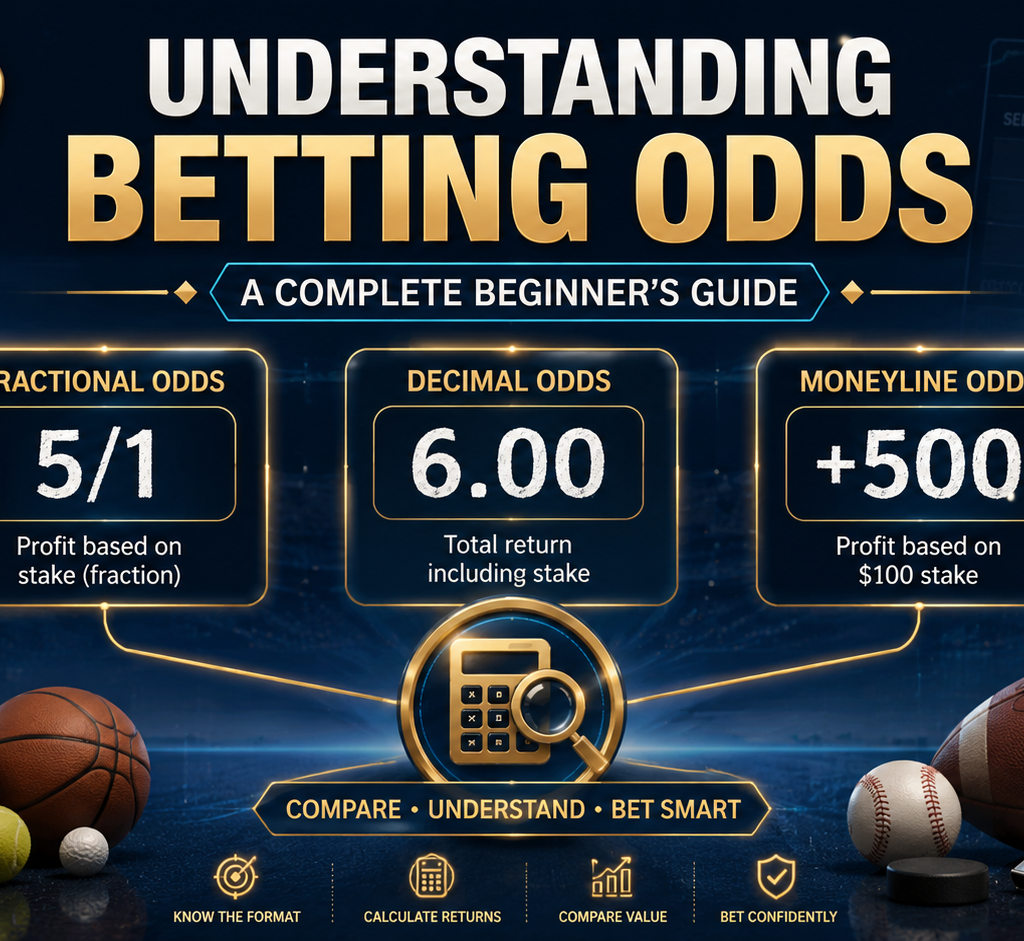
Betting odds tell you two things at once: how likely something is to happen, and how much you’ll win if it does. That’s genuinely all they are. The confusing part isn’t the concept — it’s that odds show up in three different formats, and nobody ever explains which one you’re actually looking at.
If you’ve opened a betting market and seen a number like 1.85, or a fraction like 5/6, or a plus/minus sign like +150, and quietly moved on without understanding it, this is the explanation that should have come first.
The Three Formats You’ll Actually See
Decimal Odds
Decimal vs fractional odds is the comparison most beginners get stuck on, so start here since decimal is the simpler of the two. A decimal like 1.85 tells you your total return for every 1 staked, including your original stake. Bet 100 at 1.85, and a win pays 185 total — 85 profit plus your 100 back. Most Indian platforms, including YO99, default to this format because the math is straightforward: stake × decimal odds = total payout.
Fractional Odds
Fractional odds, like 5/6, show profit relative to your stake rather than total return. A 5/6 fraction means you win 5 for every 6 staked. So 120 staked at 5/6 returns 100 profit, plus your 120 back. This format is more common on UK-style sportsbooks and can take a moment longer to calculate mentally than decimal.
Moneyline (American) Odds
You’ll see these less often on Indian platforms, but they show up on international markets. A plus sign (+150) shows profit on a 100 stake for an underdog; a minus sign (-150) shows how much you’d need to stake to profit 100 on a favourite. +150 means 100 staked profits 150. -150 means you’d need to stake 150 to profit 100.
Why the Number Itself Tells You the Favourite
Regardless of format, lower decimal odds (closer to 1.00) mean the market considers that outcome more likely — and the payout is smaller because there’s less risk being taken on. Higher odds mean the opposite: less likely, bigger potential payout. This is the part that actually matters for reading a market at a glance — the number is a probability estimate before it’s anything else.
Odds Change Because Money Moves, Not Because the Match Does
A common misunderstanding: odds shifting mid-match doesn’t only reflect what’s happening on the field. It also reflects where money is being placed. If a large volume of bets comes in on one side, the platform may adjust the price to balance its own exposure, even before the next ball is bowled. Reading a live market means watching both the game and the money, not just the game.
A Quick Way to Sanity-Check Any Odds Format
Decimal below 2.00 means the market sees that outcome as more likely than not (better than even money).
Fractional odds larger than 1/1 (evens), like 5/1, signal a genuine underdog.
A minus sign in moneyline odds always marks the favourite — the bigger the minus number, the stronger the favourite.
The Bottom Line
Odds aren’t a code to crack — they’re just a price, shown in one of three formats. Once you know which format you’re looking at and what the number actually represents, reading any market gets a lot faster, whether it’s a cricket match, a football fixture, or a casino table.
Frequently Asked Questions
Which odds format is most common in India?
Decimal odds are the most widely used format on Indian betting platforms, mainly because the payout math is the simplest to calculate directly from your stake.
Do higher odds always mean a better bet?
Not necessarily. Higher odds mean a bigger potential payout, but they also mean the market considers that outcome less likely. Higher odds reflect higher risk, not better value on their own.
Why do odds change before a match even starts?
Odds can shift based on team news, weather, or simply where bettors are placing their money — platforms adjust prices to manage their own exposure across a market.
Can I convert between decimal, fractional, and moneyline odds?
Yes, all three formats represent the same underlying probability and can be mathematically converted between one another, though most platforms let you pick your preferred display format instead.
This article is for informational and educational purposes only and does not constitute betting advice. Online betting involves financial risk. 18+ only. Please gamble responsibly.